Thanks, SpeedCurve!

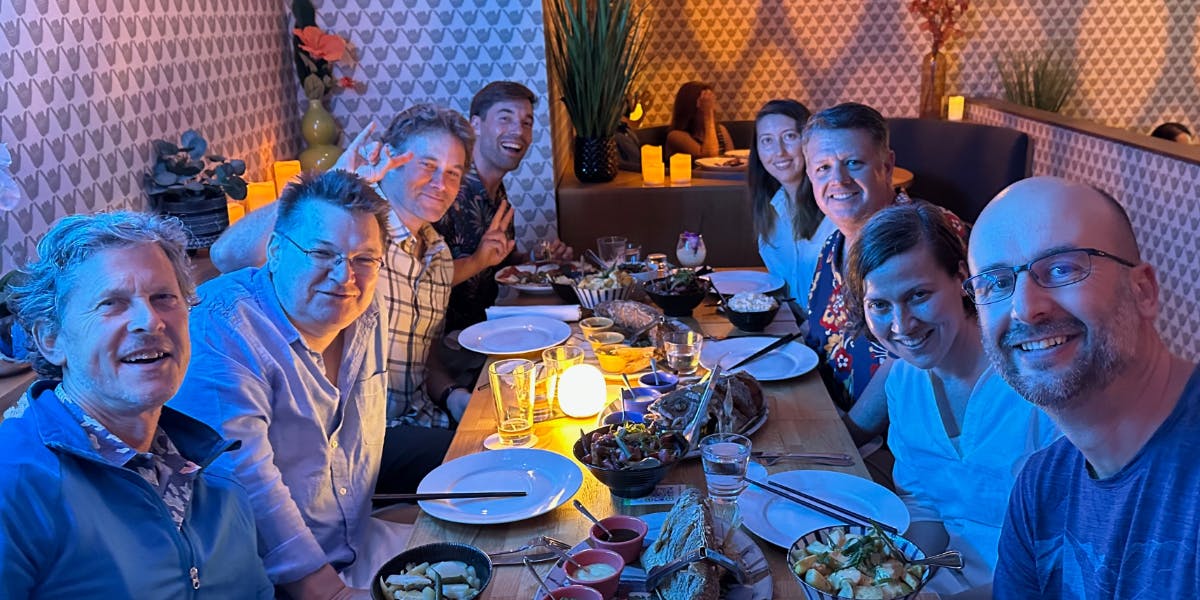
For years, at every team offsite, we’ve ended the week the same way. Somebody raises a glass and we all say "Thanks, SpeedCurve!"
This is the last post on the SpeedCurve blog, so I want to raise a glass one more time.
Here's the news. Over the next year, SpeedCurve is graduating. Our web and mobile monitoring is joining forces with Palo Alto Networks' back-end observability to become XCOR, a complete front-to-back observability platform. We'll fully support SpeedCurve monitoring through to late October 2027, as we migrate customers to our new platform.
That sounds like an ending, but it’s not. To me, it feels like graduation day. You look back at everything that got you here, you thank the people who believed in you, and then you turn around and get really excited about what's next.
So that's what this post is – a valedictory speech, minus the polyester gown and uncomfortable shoes.
First, the practical stuff for SpeedCurve customers
Nothing is changing for you today. Your synthetic tests are still running. Your RUM data is still flowing. Your dashboards, budgets, and alerts are exactly where you left them. And we're still here – the same people who’ve been answering your questions and digging into your weird edge cases for years. (We love the weird edge cases.)
Over the next twelve months, we'll move you over to XCOR. Keep an eye on your inbox for an email from us with more details on next steps.
A few things I want to be really clear about:
- You have time. Twelve months is a long runway, and that's intentional.
- You won't be doing this alone. We have a migration plan. We’ll walk you through it and support you every step of the way.
- Your support doesn't stop. Until the very last day, SpeedCurve will be a fully supported product.
Okay, now that the practical stuff is out of the way, I want to tell a little story about where SpeedCurve came from and the epic journey we’ve been on for the past thirteen years.
Where we came from
SpeedCurve started in 2013 with Mark Zeman.
Mark isn't a performance engineer by training. He's a designer. He built his first website in Mosaic, back when the <img> tag was brand new, and he spent years as a teacher and creative director before he ever got started with performance. I think that's the whole secret of SpeedCurve. It was built by someone who cares just as much about how a page feels as how fast it loads, and who refuses to accept that those are two different questions.
Mark also refused to accept that performance was only for developers and engineers. He was a true pioneer in visualizing data in ways that made performance accessible and interesting. (I’ve lost count of how many times SpeedCurve customers have raved to me about how much they love our charts and dashboards.)
Our beta launched at the O’Reilly Velocity conference, with a shoutout on the stage from Steve Souders, who went on to join Mark and become SpeedCurve's other guiding light.
If you've spent more than ten minutes in this industry, you know Steve. He literally wrote the book(s) on performance. He gave this field its vocabulary and then spent years helping us turn it into tools people actually enjoy using. More importantly, Steve connected so many of us and is the reason why the performance community remains one of the most collegial, warm, tight knit groups I’ve ever been privileged to be part of.
When SpeedCurve joined Embrace last year, Mark wrote this post: Performance is about people
It's very Mark: a little bit cosmic, a little bit cyberpunk, and completely sincere. In it, he made a point I've been trying to make for years without ever saying it as well. SpeedCurve looks like a bunch of charts. But it was actually always a tool for having conversations – about your users, about what makes them happy or unhappy, and about what your organization owes them.
He also wrote this, which I'd like to put on a t-shirt someday: "Each of us is on a speed curve."
A few years ago, at one of our offsites, Mark told our team, "I trust all of you implicitly." I've had lots of great bosses, but nobody had ever said anything like that before. It’s one of the most meaningful things anyone has ever said to me and I’ll hold it in my heart forever. SpeedCurve was never my company, but I've felt a level of commitment here that I've never felt anywhere else, and that one sentence is a big part of why.
Mark, thank you. For the vision, for the trust, and for building something that so many people have cared about this much.
The people who made SpeedCurve special
I joined SpeedCurve in 2017 as employee #1. At the time, I explained my decision like this: "If Mark and Steve invited you to work with them, what would you say? Exactly."
As someone who really, really, REALLY likes being right, I'm happy to report: I was right.
Other than being a wife and mom, I've never done anything for this long. (Like a lot of folks in tech, I'm a bit of a serial monogamist. Three to five years, then itchy feet.) Almost ten years later, my feet are still happily planted.
When I said yes, Steve said, "Yay, this is going to be fun!" He was right, too. It's been a ridiculous amount of fun, and that’s largely because of the people. SpeedCurve has always been a small team, and that was never a limitation. That was the whole point. When you emailed support, you got someone who'd built the thing, or someone who'd spent years explaining the thing at conferences – and often both!
Some of these people have moved on to other adventures. I want everyone’s names here, on the record:
Joseph Wynn, who joined SpeedCurve shortly after I did. If you love reliability, security, and accessibility, then you have Joseph to thank for leading the charge on all those fronts. And he’ll be continuing to do this with XCOR – lucky us! (He’s also a wicked surfer and is the reason why I ignored my self-doubt and climbed on a board – and stayed up! – for the first and probably last time at an offsite back in 2018.)
Cliff Crocker, my work BFF, whom I've known since long before either of us came to SpeedCurve. We’ve worked together at SOASTA, then for years at SpeedCurve, and we’ll keep working together at XCOR. If you’ve ever met Cliff, then you know he’s a rock. He cares about everyone – customers, team members, end users – and he brings a massive amount of skill and experience to making awesome tools and an awesome culture.
Elena Kay, who wrote so much of the code underneath everything you've ever clicked on in SpeedCurve. When she wasn’t building code, she was inspiring us all with her offline adventures – ice climbing, mountaineering, and running marathons.
Andy Davies, who is one of the OG web performance gang. I don't even remember when we met. He's just always been there! What Andy doesn’t know about performance isn’t worth knowing. He’ll be continuing to build the best front-end monitoring in the world with our XCOR team.
Andy Biggs (AKA Biggs, because when you're in an eight-person company, two people with the same name breaks your brain) brought a massive amount of creativity to the table. He challenged us to think about performance in fresh ways and he’s directly responsible for reimagining many of your SpeedCurve dashboards. (If you love your Vitals dashboard as much as I do, give the credit to Biggs!)
That’s it – our entire team. Every time a customer learns that SpeedCurve was built and supported by just eight people, it blows their mind. It’s amazing what eight humans can do when you all care and are pulling in the same direction.
As I mentioned, many of us are carrying the torch forward at Palo Alto Networks’ XCOR platform. Here’s what I’m excited about…
What we're bringing with us
In early 2025, on my eighth work anniversary, I tried to pin down why SpeedCurve has felt like such a good home. I landed on a handful of things: a shared vision of building tools that genuinely help people. Trust. Integrity. Humanity – meaning the kind of workplace where life can knock you sideways for a while and nobody makes you worry about your job while you heal. And fun. Lots of fun.
Here's what makes me excited instead of wistful: when we started getting to know our new comrades at Palo Alto Networks, we kept finding the same things. The same vision, same goals, same commitment to trust and integrity and treating people like people. Even the same sense of humour, which – trust me – is not a given.
We didn't just find a new home for our technology. We found our people.
What we’re building
Together we're building something bigger than any of us could build alone. The web has changed a lot since 2013. Your users don't live on a single site anymore. They move between web and mobile, and the experience they have depends on everything from the front end all the way back to the infrastructure.
The problems are getting harder and more interesting. Part of what’s making them harder is AI: teams are shipping more code, and they’re shipping faster, which means more ways for things to break. We’re putting AI to work on the other side of that equation, digging through the whole stack to find the root cause when something goes wrong.
Yes, it’s fuelled by AI, but ultimately humans are at the centre. We’re helping humans spend less time hunting for needles in haystacks so they can spend more time building and optimizing. And – most important – we never lose our connection to our users on the other side of the screen.
That last bit is everything. For years and years, we've argued on this blog that performance isn't really about milliseconds. It's about people. The person on the spotty train connection who just needs to DO THE THING before the train goes into a tunnel. The person who gives up on your checkout in frustration and never comes back. People are central to everything we build next.
One last toast
To everyone who ever ran a test, set a performance budget, sent us a bug report or a feature request, came to one of our talks, or argued with us on the internet about which metric matters most: thank you. You made this the best job I've ever had.
To Mark, Steve, and every SpeedCurver past and present: thank you for the epic ride.
To our new friends at Palo Alto Networks: I can't wait to see what we build together.
In the funny way time has, the last decade feels like a long time and like no time at all. So, glasses up, one more time...
Thanks, SpeedCurve!