The speed of trust: How slow pages hurt your brand

Performance isn’t just a technical metric or a revenue lever. It’s a perception engine. Every delay subtly reshapes how users evaluate your credibility, professionalism, and trustworthiness. Once perception shifts, it’s difficult to reverse.
We’ve known for years that slow pages hurt conversion rates. They increase bounce. They reduce revenue. They drag down engagement.
But there’s another cost that’s harder to measure and potentially more damaging in the long term: Slow pages change how people feel about your brand.
Research: Slow pages undermine brand perception
Years ago, I led what was, to me, a fascinating neuromarketing research project that asked the question: do mobile users experience stress when pages slow down?
The reason why we wanted to ask this question was because at the time there was a widespread belief that people are more patient on our mobile devices because we expect a slower experience. The point of this research was to find out how delays make us feel, despite our learned expectations.
The study involved a groundbreaking combination of eyetracking and electroencephalography (EEG) technologies to monitor neural activity in a group of participants who were asked to perform a series of online transactions on mobile devices. Some users experienced fast versions of the site, while others experienced artificially throttled slower versions.
The participants did not know that speed was a factor in the tests; rather, they believed they were participating in a generic usability/brand perception study.
Each participant was given an exit interview after completing their tasks. They were asked to give their impressions of the site and the company. All the adjectives from the interviews were poured into a word cloud generator, which generated clouds for each version (fast and slow) of each site.
Compare these word clouds generated from the fast versus slow experiences:
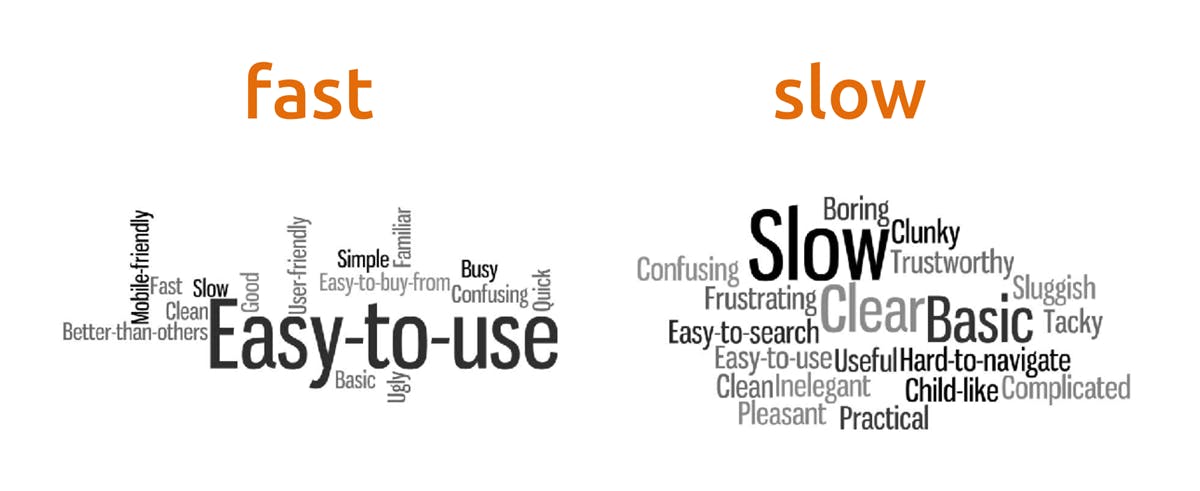
While it’s true that both word clouds contain positive and negative descriptors, it is important to note that the word cloud for the slower site contains almost three times more negative adjectives than the faster site. The adjectives shift from mainly easy-to-use (in the first word cloud) to a range of negative associations (in the second word cloud) – solely because of the page delays.
While some participants clearly picked up on the slight deterioration in performance ("slow" and "sluggish"), participants also developed negative perceptions of areas that are unrelated to speed. They reported that the site seemed "boring", "inelegant", "clunky", "tacky", and “hard to navigate".
In other words, slower page loads affected people’s perception of three important aspects of the site that are completely unrelated to load time:
- Content – "boring"
- Visual design – "tacky” and "confusing"
- Ease of navigation – "frustrating" and "hard-to-navigate"
Now let's explore why speed affects brand perception and how this affects your business...
Waiting creates micro-stress
When a page stalls, uncertainty creeps in:
Did my click register?
Is something broken?
Should I refresh?
Even small delays create cognitive friction. The brain has to hold context longer. Multiply that across a journey, and the cost compounds. The result isn’t just impatience. It’s reduced goodwill.
Just one slow step can define the whole experience
People don’t average their experiences. They remember the peak moments and the ending.
You can deliver five fast interactions in a row, but if checkout stalls, that’s what sticks. Human perception is disproportionately influenced by peaks and endings. A slow checkout step or a laggy search interaction can overshadow earlier smooth performance. That's why consistency matters as much as speed.
Speed signals competence and trustworthiness
We associate smooth, responsive experiences with technical excellence. Delays can signal disorganization or lack of investment. Users don’t see the complexity behind performance issues. They judge what they experience.
Never underestimate the fragility of trust online. Users are constantly evaluating whether a site feels safe enough to enter personal details and complete transactions. Slow load times or janky interactions can subtly undermine that trust. When pages lag, people start to question other things, like...
If checkout hangs, will my order go through?
If interactions feel sluggish, is the company disorganized? Will my order even arrive?
Even if everything works in the end, rendering delays and visual instability erode your users' confidence.
Speed is a competitive differentiator
These days, it's never been easier to comparison shop. So when products and pricing are similar, user experience becomes the competitive differentiator.
Fast, smooth interactions reduce effort. Reduced effort feels like respect for the user’s time. When competitors offer comparable features, the company that feels easier to interact with often wins – even if the difference is subtle.
Performance is rarely marketed explicitly, but it quietly becomes part of the overall brand: "This company just feels better to deal with."
Takeaways
- Performance shapes brand perception. Slow pages subtly erode credibility and trust.
- Users judge emotionally, not numerically. They remember how the experience felt, not specific load times.
- Speed creates a halo effect. Fast experiences signal competence and trustworthiness.
- Slowness lingers. Even minor delays can influence long-term memory and future behavior.
- One bad moment can dominate perception. Consistency across the entire journey is critical.
- Performance differentiates you in competitive markets. It's as much a brand asset as your design and content.